
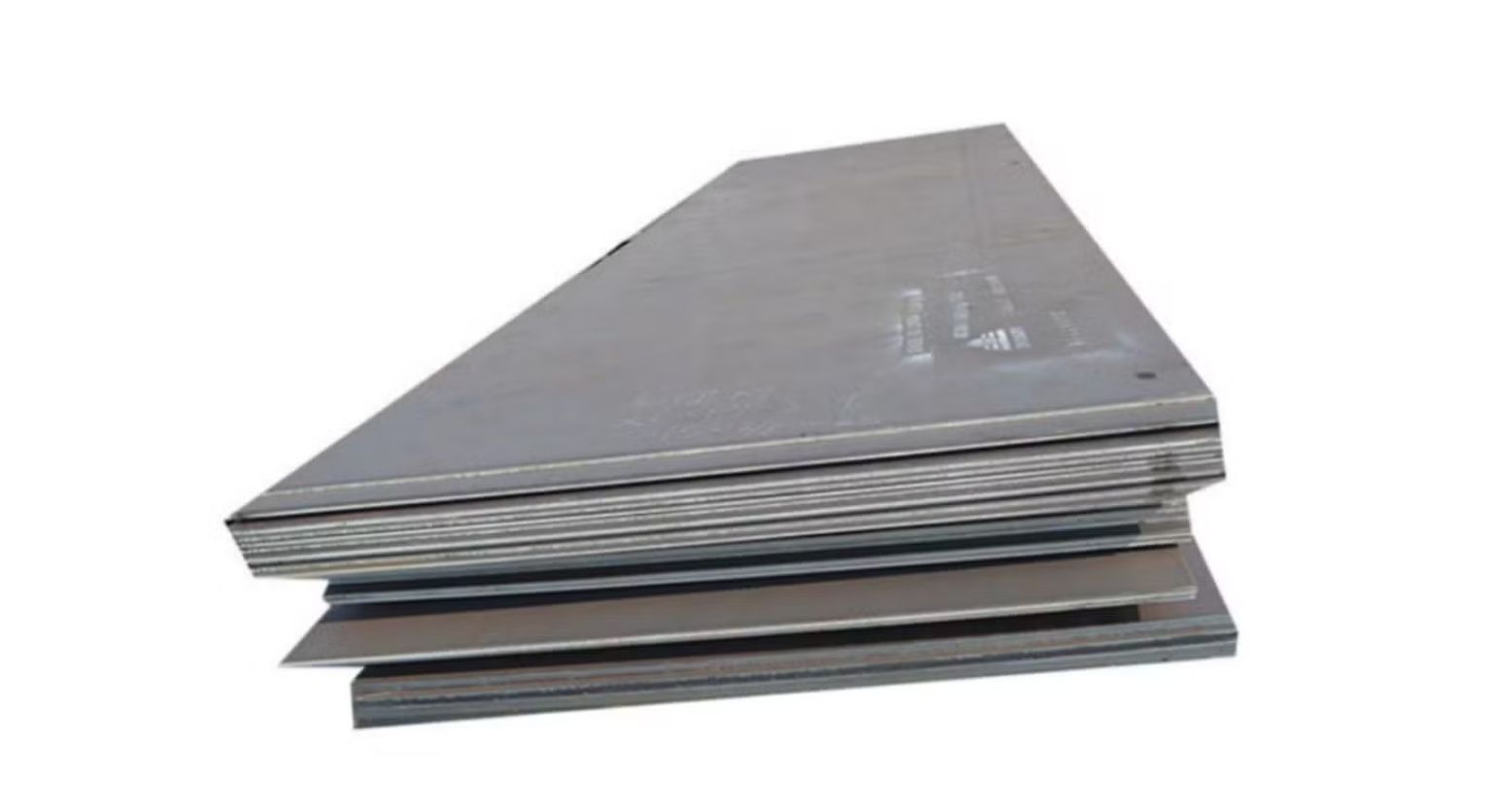
Mining equipment battles rock, ore, and mineral particles every shift. Crusher jaws compress granite continuously. Excavator buckets scrape against hard rock faces. Dump truck bodies absorb impact loads of over 100 tonnes per cycle. The choice of material is even more crucial for parts that are subject to wear, because it determines how long a machine can continue to operate before it has to be rebuilt. Engineers specifying grades for mining know this trade-off. Mining grade 400 BHN plates are harder, cost more initially but the cost of early failure and the resulting unscheduled downtime is compounded.
What Are 400 BHN Plates?
BHN stands for Brinell Hardness Number, the result of pressing a tungsten carbide ball into the steel surface and measuring the indentation diameter. Standard structural grades like IS 2062 E250 carry 120-160 BHN. At 400 BHN, wear plates run roughly 2.5 times harder, achieved through alloying with boron, chromium, manganese, and carbon combined with controlled quenching to produce a martensitic microstructure. The tensile strength is 1250-1350 MPa and the yield strength is 1000-1100 MPa, so these plates are suitable for continuous contact with mineral particles and rock.
Key Properties of 400 BHN Steel Plates
High Wear Resistance
ASTM G65 abrasion testing shows 400 BHN material losing 60-70% less volume than mild steel under identical conditions. The martensitic matrix resists surface cutting by ore particles that erode softer steel within weeks.
Superior Hardness
Through-thickness hardness of 370-430 HBW ensures wear resistance is maintained as the surface erodes, unlike case-hardened components that fail once their hard outer layer wears through.
Good Impact Strength
Charpy toughness runs 27-40 joules at 0°C, absorbing shock loads without cracking. Higher-hardness 500 BHN grades risk brittle fracture under the same cyclic conditions.
Extended Service Life
Field data from quarry and open pit operations shows 400 BHN plates achieving 3 to 5 times the service life of mild steel in comparable applications.
Excellent Fabrication Capability
Standard GMAW and SMAW welding applies at 100-150°C preheat for plates up to 20mm, and cold forming to 3-4 times plate thickness makes 400 BHN practical for curved liners and hopper walls.
Why 400 BHN Plates Are Ideal for Mining Equipment
Resistance to Abrasive Wear
Silica and iron oxide minerals carry Mohs hardness values of 5.5 to 7. At 400 BHN, plate surface hardness exceeds most rock-forming minerals, limiting particle cutting across crusher chambers, bucket floors, and chutes.
Improved Equipment Lifespan
A primary crusher offline for liner replacement loses 8 to 24 production hours. Running 400 BHN liners extends change-out intervals by 3x or more over mild steel.
Reduced Maintenance Costs
Fewer replacements mean fewer shutdowns and reduced fitter time. For three-shift continuous operations, 400 BHN in high-wear zones cuts unplanned stoppages where mild steel fails mid-cycle.
Enhanced Operational Efficiency
Worn liners shift crusher geometry, reducing throughput and raising power consumption per tonne.
Better Return on Investment
400 BHN plate costs 30-50% more per kilogram than mild steel. Factor in 3 to 5 times the service life, and cost per tonne of ore processed drops considerably, especially in hard siliceous environments.
Applications of Wear Resistant 400 BHN Plates in Mining
Crusher Liners
Jaw crusher swing plates, cone crusher mantles, and impact crusher blow bars face abrasion and impact every cycle. 400 BHN extends service intervals across all three types.
Excavator Buckets
Bucket floors, side cutters, and wear strips contact abrasive rock thousands of times per shift. 400 BHN sections protect the structural shell and defer costly repairs.
Dump Truck Bodies
Hard rock ore impacts truck body floors and walls on every load cycle. 400 BHN lining reduces deformation, particularly with coarse and angular material.
Chutes and Hoppers
Ore sliding through chutes erodes mild steel quickly. 400 BHN liners at impact zones and sliding faces cut replacement frequency by half to two-thirds.
Conveyor Systems
Transfer point wear liner packages built from 400 BHN protect support structures at belt drop points, reducing structural maintenance costs.
Screening and Processing Equipment
Vibrating screens, grizzly bars, and trommel liners face continuous ore abrasion. 400 BHN maintains screening geometry and extends service intervals.
Advantages of Abrasion Resistant Steel Plates in Mining
Longer equipment life reduces capital expenditure on major wear assemblies. A primary crusher offline during peak production costs 50,000 to 200,000 rupees per hour in lost throughput, making reduced downtime a direct financial argument, and fewer change-outs reduce crew exposure in high-risk zones. Lower maintenance costs accumulate across a mine’s full production life, making abrasion resistant steel plates a high-return material substitution in heavy industry.
Factors to Consider When Selecting 400 BHN Steel Plates
Type of Mining Operation
Open pit and quarry operations run larger equipment against harder ore than underground environments. Both suit 400 BHN, but thickness requirements and fabrication constraints differ between the two.
Wear Conditions
Pure sliding abrasion favours maximum surface hardness. Heavy cyclic impact applications like crusher liners and truck bodies need the hardness-toughness balance 400 BHN provides, since higher-hardness grades risk brittle fracture.
Plate Thickness Requirements
Chute liners run 10-20mm. Crusher liners often need 25-40mm. Dump truck body liners use 8-16mm. Thickness depends on wear rate, structural loading, and planned replacement interval.
Fabrication Requirements
Welding 400 BHN to mild steel requires low-hydrogen consumables and consistent preheat to prevent heat-affected zone cracking. Operations needing curved profiles should verify formability at the required thickness.
Conclusion
400 BHN plates combine the hardness to resist abrasive minerals, the toughness to handle impact loads, and the weldability suited to field fabrication. Wear resistant 400 BHN plates in crushers, excavators, hoppers, and conveyor systems return 3 to 5 times the service life of mild steel. Abrasion resistant steel plates at this hardness grade have become the standard specification wherever lower-hardness materials fail too quickly to stay cost-effective. Metal Ore supplies high-quality wear-resistant steel plates designed to meet the demanding requirements of mining and heavy industrial applications, backed by 24 years of sourcing steel of international standards for India’s most demanding sectors.