
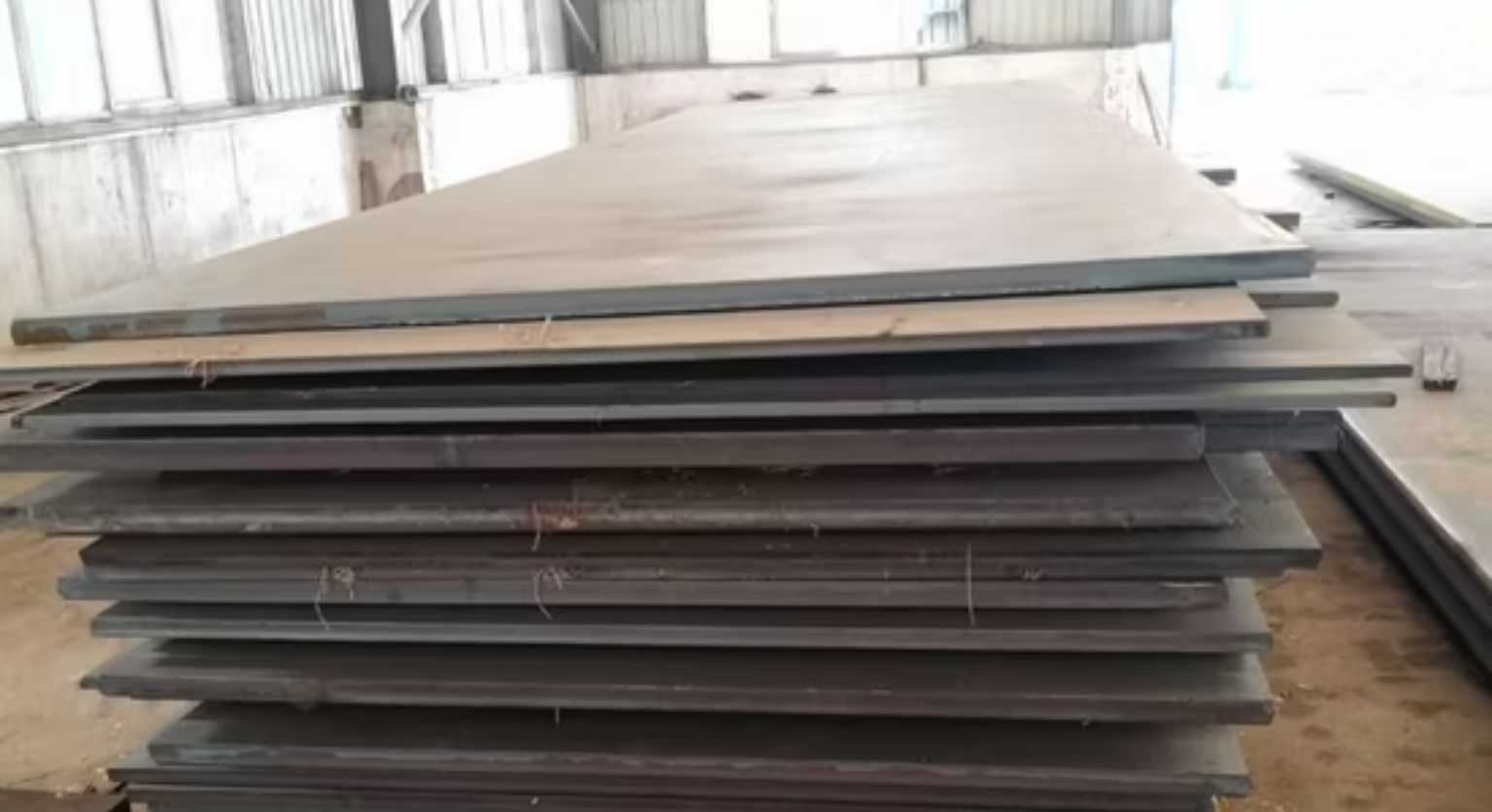
Medium carbon steel offers a practical balance of easy workability and reliable strength. Among the grades that occupy this space, C45 steel plates stand out for combining tensile strength in the range of 570 to 700 MPa with a machinability that makes them easy to cut, drill, and shape on standard equipment. Engineers in automotive, construction and heavy manufacturing regularly specify industrial C45 steel plates because they stand up to the load without the complex processing that high-alloy grades demand. This guide covers composition, properties, advantages and real-world applications of C45 carbon steel plates.
What Are C45 Steel Plates?
C45 steel plates belong to the medium carbon steel category, with a carbon content between 0.42% and 0.50%. That carbon range positions the grade above mild steel in strength while keeping it well short of the brittleness that comes with high-carbon variants. Widely recognised under the EN 10083 standard, C45 also corresponds to the EN8 steel plates designation used in British and Indian engineering practice, making it a genuinely cross-border grade with consistent recognition across supply chains. Plates come in thicknesses from 3 mm up to 150 mm and beyond, with standard widths matching IS, ASTM A29, and DIN EN 10083-2 specifications depending on the application and sourcing region.
Chemical Composition of C45 Carbon Steel Plates
Key Elements
- Carbon, 0.42% to 0.50%, is the primary contributor to strength and hardness
- Manganese (Mn), 0.50% to 0.80%, refines grain structure and improves hardenability
- Silicon (Si), 0.17% to 0.37%, deoxidises the melt and raises tensile strength slightly
- Sulfur (S), maximum 0.045%, kept low to avoid hot shortness during rolling
- Phosphorus (P), maximum 0.045%, controlled to prevent brittleness at grain boundaries
Impact of Composition
- The carbon-manganese balance delivers consistent strength enhancement without requiring complex alloying.
- Silicon and controlled manganese levels give a surface hardness of 170 to 210 HB in the normalised condition, giving wear resistance on sliding contact surfaces.
- The low content of sulphur and phosphorus improves machinability by reducing tool wear in both turning and milling operations.
Key Properties of C45 Steel Plates
High Mechanical Strength
Normalised C45 plates reach a tensile strength of 570 to 700 MPa and a yield strength of around 305 MPa. That profile suits heavy-duty engineering components where structural integrity under static and cyclic loads is non-negotiable.
Good Hardness
After through hardening and tempering, surface hardness climbs to 55 to 62 HRC depending on section thickness and quench medium. This level of wear resistance makes the grade practical for components that run against abrasive surfaces in service.
Superior Machinability
In the annealed or normalised condition, C45 machines are consistently used on conventional lathes and CNC equipment. You can predict the cutting speeds, tool life and surface finish, so it cuts down on production time compared to stainless or nickel-based alternatives.
Good Toughness
Impact toughness at room temperature averages 35 to 50 J on a standard Charpy V-notch test. That result reflects a material capable of absorbing sudden shock loads, a quality that matters in gearboxes, shafts, and other drivetrain components.
Heat Treatability
Full annealing, normalising, quenching and tempering, and induction hardening all work reliably with C45. Each treatment pathway targets a different performance outcome, giving design engineers flexibility to optimise hardness, toughness, or machinability depending on the end use.
Advantages of C45 Carbon Steel Plates
Excellent Strength-to-Cost Ratio
C45 is less expensive than alloy grades such as 42CrMo4 or EN24, and it performs just as well in non-corrosive environments. For high-volume production runs, that price gap matters directly to project economics.
Versatile Industrial Applications
A single grade covers automotive, construction, mining, and agricultural sectors without reformulation. Procurement teams can standardise on one grade across multiple product families, simplifying inventory.
Good Wear Resistance
Heat-treated C45 handles sliding and abrasive contact without rapid surface degradation. Components in conveyor systems, crusher frames, and press tool guides regularly run extended service intervals on this grade.
Easy Fabrication
Plasma cutting, sawing, and drilling all work efficiently on C45 in its normalised state. Shops with standard fabrication equipment can process plates without specialist tooling, which shortens lead times on mechanical assemblies.
Long Service Life
C45 components in abrasive service in dry or low moisture industrial environments have been found to routinely have a life two to three times that of equivalent mild steel components, as indicated by field data from mining and material handling installations.
Industrial Uses of EN8 Steel Plates
Manufacturing Industry: The C45 plate is used for machine frames and structural housings for presses, lathes and milling equipment, providing stiffness and load bearing capacity.
Automotive Industry: C45 heat treatment is vital for passenger cars and commercial vehicles which have gears, shafts and axles. This ensures the fatigue resistance stays consistent over millions of load cycles.
Construction Sector: Structural connectors, support brackets and equipment mounting pads in industrial buildings. EN8 steel plates are specified where mild steel does not have the required yield strength.
Heavy Engineering: Equipment bases for hydraulic presses, rolling mills, and forging hammers use thick C45 plate sections to absorb vibration and resist deformation under sustained compressive loads.
Mining and Material Handling: Wear-resistant components in crushers, conveyors, and screening equipment use hardened C45 where replacement intervals and downtime costs drive material selection.
Agricultural Equipment: Tillage tools, plough blades, and harvester components manufactured from C45 perform through abrasive soil contact seasons without frequent replacement.
Common Components Manufactured Using C45 Steel Plates
Fabricators and machinists cut C45 plate into a broad range of finished parts. Gears and shafts make up the largest volume segment, followed by bolts and studs for high-load structural connections. Couplings, machine parts for press tools and jigs, and load-bearing structural components all draw on the same plate stock, making C45 one of the more versatile single-grade choices in a medium-carbon inventory.
Factors to Consider When Selecting C45 Steel Plates
Load requirements determine whether a normalised or heat-treated condition suits the application, with through-hardened plates specified where surface stress exceeds 450 MPa contact pressure. The choice of thickness and surface treatment depends on the wear conditions, particularly when there is sliding or abrasion. Machining should be done to the annealed condition for complex geometries with tight tolerances. Heat treatment requirements should be confirmed before ordering, since heavy sections above 60 mm see reduced core hardness after quenching. Industry standards including IS 1570 Part 2, EN 10083-2, and ASTM A29 apply to different markets, and procurement teams should confirm the applicable specification with their supplier before placing orders.
Conclusion
C45 steel plates occupy a well-established position in industrial and engineering supply chains because they deliver consistent mechanical performance at a cost that works across high-volume applications. Sourcing and processing higher alloy alternatives can be complex, this grade removes much of the complexity by combining strength, machinability and heat treatability in one grade. C45 carbon steel plates and EN8 steel plates can perform in demanding service conditions from automotive drivelines to mining equipment frames, without the need for specialist handling. Metal Ore is a supplier of C45 plates as per EN 10083-2, IS 1570, ASTM A29. We have 24 years of experience in industrial steel supply. When strength and durability and cost efficiency all matter in applications, C45 still is a reliable and practical choice.