
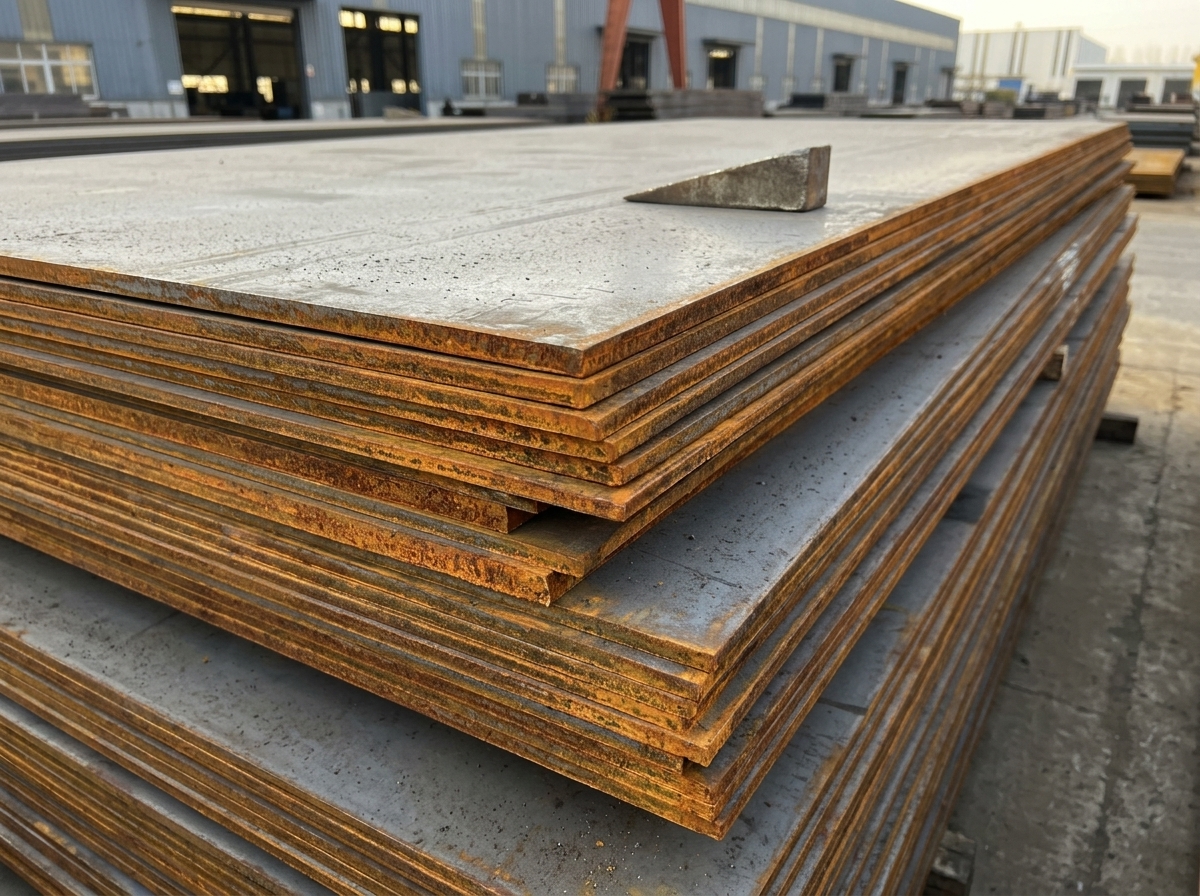
Steel grade selection is only half the decision. Plate thickness determines whether a finished structure meets load requirements, survives its service environment, and comes in on budget. For buyers sourcing carbon steel plates for structural and fabrication work, the carbon steel plate ASTM A36 grade anchors most thickness discussions. The grade earns that position.
ASTM A36 plates cover a wide range of industrial use cases, from bridge girders and column base plates to storage tanks and heavy machinery frames. Consistent mechanical properties, predictable weld behavior, and competitive cost per tone drive that breadth of use. Specifying the wrong thickness and even A36’s forgiving chemistry creates problems: structures failing load audits, over-specified plates driving up costs, or stock too thick for available forming equipment. Thickness is where structural performance, durability, and project economics converge.
What Are ASTM A36 Carbon Steel Plates?
ASTM A36 is a low-carbon structural steel specification with a maximum carbon of 0.26% and manganese between 0.60% and 0.90%. That chemistry delivers a minimum yield strength of 250 MPa (36,000 psi) and tensile strength between 400 and 550 MPa, with 20% elongation in a 200 mm gauge length. Hot rolled production gives the plate a consistent grain structure through its thickness, and mill-scale surface preparation suits most weld setups without additional conditioning.
Weldability is the grade’s strongest practical argument for fabricators. The carbon equivalent for standard A36 stock is below 0.40, keeping pre-heat requirements minimal for sections under 25 mm. SMAW, GMAW, FCAW, and SAW all produce sound welds with standard procedures, making ASTM A36 structural steel plates the default choice for general-purpose structural work across most industrial sectors.
Understanding ASTM A36 Plate Thickness
Standard ASTM A36 carbon steel ASTM A36 plates ship in thicknesses from 3 mm up to 150 mm and beyond. Three commercial classifications apply:
Thin plates (3–12 mm): light fabrication, guards, secondary structural members
Medium plates (12–50 mm): primary structural fabrication, beam webs, brackets
Heavy plates (50 mm+): bridge abutments, large equipment bases, specialist heavy engineering
ASTM A6 dimensional tolerances allow thickness to run over nominal but not under, with roughly 0.78 mm permitted over-tolerance for plates under 25 mm. Weight scales directly with thickness: a 1,200 mm x 2,400 mm A36 plate at 10 mm weighs approximately 226 kg; the same footprint at 50 mm reaches around 1,130 kg. That difference compounds across freight costs, crane capacity, and total project steel tonnage.
Factors to Consider When Choosing ASTM A36 Plate Thickness
Structural Load Requirements
Static dead loads set a calculable baseline, but dynamic and impact loads complicate the picture. Repeated cycling from vibration, crane operations, or vessel filling generates fatigue stresses that accumulate faster in thinner cross-sections. Applications combining sustained static loads with cyclic operational forces consistently push thickness selections toward the higher end of any engineered range.
Application Environment
Dry indoor fabrication places no special demands on A36 beyond its standard specification. Outdoor use in coastal or humid environments turns plate thickness into a corrosion management variable. Adding 1.5 mm to 3 mm above the structural minimum extends service life without a grade change. Cold-region projects below minus 20°C hit A36’s notch toughness limits; thickness increases alone cannot resolve that, and some applications require Charpy impact testing or a tougher grade entirely.
Fabrication and Welding Requirements
Plasma cutting handles hot rolled steel plates up to about 50 mm efficiently; oxy-fuel takes over above that. Press braking above 20 mm requires significant machine tonnage. Plates above 25 mm typically need pre-heating to 65°C or higher to prevent hydrogen cracking in restrained joints. Multi-pass welding for heavy sections adds substantial labour hours, and a lighter plate with added stiffeners often proves more economical on repeated fabrication runs.
Equipment and Machinery Requirements
Machinery bases and base plates have thickness requirements set by load transfer geometry, not global structural calculations alone. A base plate transmitting column loads to a concrete foundation needs enough thickness to distribute bearing stress uniformly. Undersized plates crack the grout pad within months. For industrial carbon steel plates in plant construction, equipment datasheets specify minimum thicknesses per component; treat those as design minimums.
Cost and Material Optimization
A project using a 40 mm plate where a 32 mm plate satisfies the structural calculation carries roughly 25% more steel cost per square meter, compounding across fabrication time and freight. Structural optimization with stiffeners and section geometry consistently outperforms defaulting to heavier stock. Thickness selection and structural design belong in the same engineering conversation.
ASTM A36 Plate Thickness Chart Overview
An ASTM A36 plate thickness chart groups commercially available sizes by application category. Thin plates from 3 mm to 6 mm suit light fabrication and secondary members. The 6 mm to 25 mm range covers the bulk of general structural work. Medium-heavy stock from 25 mm to 75 mm handles primary structural sections, low-pressure vessel shells, and heavy equipment bases. Above 75 mm, the grade enters specialist territory: dam structures, offshore nodes, and large foundation anchor blocks. Exact thickness selection within any category depends on engineering design specifications and load requirements for the specific project.
Common Industrial Applications of ASTM A36 Steel Plates
Structural fabrication consumes the largest share of A36 plate: columns, beams, connection gussets, and floor plates in industrial buildings and process plants. Building construction draws on A36 for base plates, moment frame connections, and beam copes. Bridge web sections benefit from the material’s elongation characteristic under traffic-induced vibration. Storage tank shells for water, fuel, and bulk solids typically run 6 mm to 16 mm. Machinery frames, equipment bases, conveyor gantries, and crusher frames all sit within A36’s commercial thickness coverage.
A36 holds its position across these sectors because no single alternative grade combines its strength level, weldability, and price point as consistently.
ASTM A36 Steel Plates vs Other Structural Steel Grades
A572 Grade 50 delivers 345 MPa minimum yield against A36’s 250 MPa, making it the right choice where section reduction matters, but it costs more per ton and demands tighter weld controls in heavy sections. S275JR overlaps A36 in mechanical properties but follows EN 10025 tolerances rather than ASTM A6. IS 2062 E250 covers similar ground under Indian standards, with Grade A and Grade B options for different impact requirements.
A36 wins in general-purpose structural work with no special toughness, temperature, or corrosion demands. Its ASTM A36 steel plate specifications carry universal recognition among fabricators, inspectors, and engineers across India, North America, and the Middle East.
Why Industrial Buyers Choose ASTM A36 Carbon Steel Plates
Wide availability, consistent fabrication behavior, and traceable mill documentation all support the procurement case for mild steel ASTM A36 plates. Fabrication shops have worked with A36 for decades: no special procedure qualifications, no unfamiliar heat treatment, no exotic consumables. Mill test certificates covering chemistry, tensile properties, and dimensional inspection satisfy most structural quality plans without supplementary testing.
Conclusion
Selecting the correct ASTM A36 plate thickness connects structural performance directly to fabrication efficiency and total project cost. Under-specified plates create structural risk; over-specified stock raises material, fabrication, and freight costs without a structural return. Load type, service environment, shop capability, and budget all feed that decision differently on every project.
MetalOre supplies ASTM A36 carbon steel plates across the full commercial thickness range, backed by over 24 years of steel import and supply experience in India. Contact MetalOre for plate sizes, ASTM A36 steel plate specifications, and guidance on matching plate thickness to your industrial requirements.