
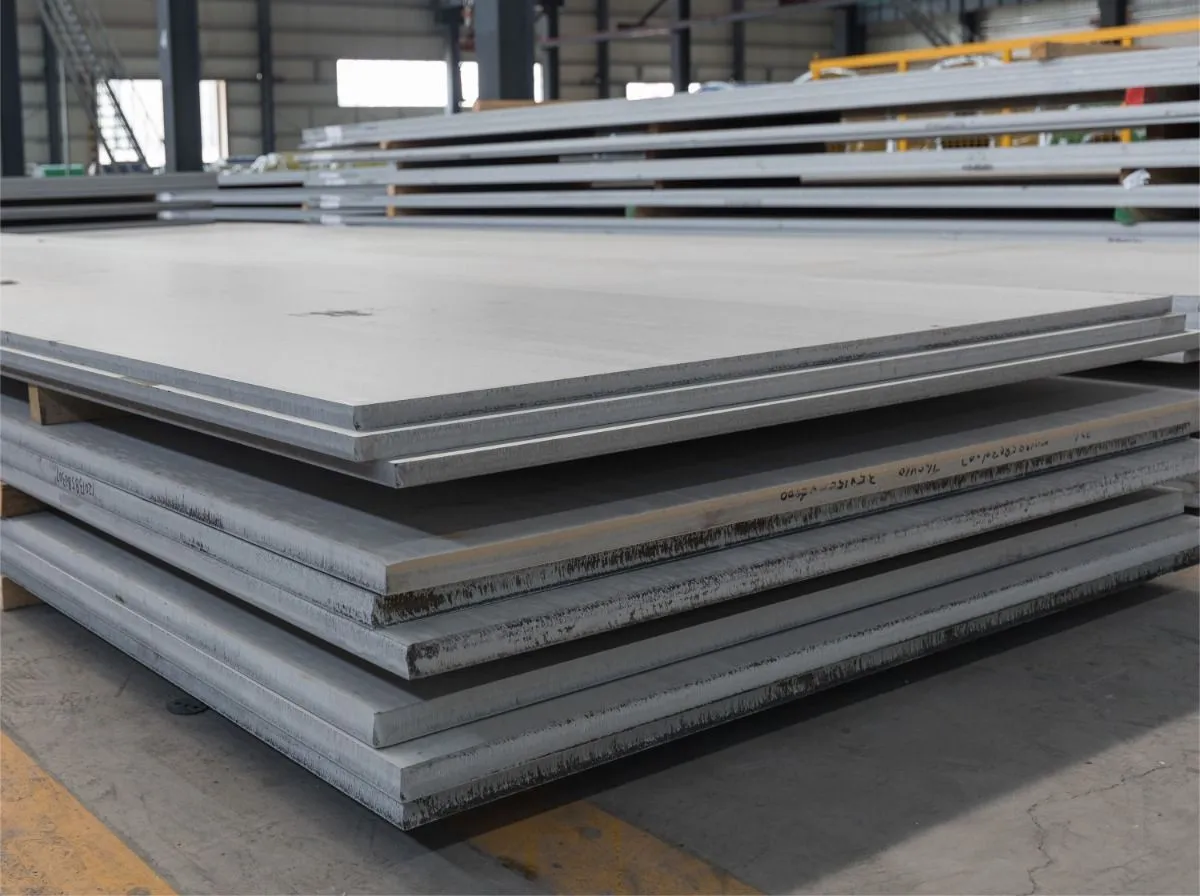
Yield strength separates these two grades. IS 2062 E250 and E350 both sit in the hot-rolled structural steel family that Indian fabricators use for beams, base plates, gussets, and equipment frames. E250 guarantees a minimum yield of 250 MPa. E350 guarantees 350 MPa, and that 100 MPa gap is the whole basis of the IS 2062 E350 vs E250 Steel Plates comparison, since IS 2062 names every grade after the yield figure it promises. Structural load, span, member geometry, and the governing design code decide which figure an engineer actually needs. Plate thickness and fabrication method then narrow the choice, because the specified yield value steps down as sections get thicker.
What Are IS 2062 E250 and E350 Steel?
Both grades are hot-rolled carbon structural steels specified under IS 2062:2011, separated by guaranteed yield strength and by tighter chemistry at the higher tier.
What are IS 2062 E250 Plates?
IS 2062 E250 Plate carries a 250 MPa minimum yield and 410 MPa minimum tensile strength, with elongation at 23 percent. Contractors use it for general building and fabrication work.
What Are IS 2062 E350 Plates?
IS 2062 E350 Plates guarantee 350 MPa minimum yield, 490 MPa tensile strength and 22 percent elongation. Carbon caps tighter at 0.20 percent, which keeps weldability workable at this strength level.
IS 2062 E350 vs E250 Steel: Key Differences
The difference between IS 2062 E350 and E250 Steel Plates shows up across seven practical parameters, all tracing back to that 100 MPa yield gap. Strength rating drives section sizing. Sizing then drives weight, welding practice, and stock cost.
| Comparison Parameter | IS 2062 E250 Steel | IS 2062 E350 Steel |
| Minimum Yield Strength | 250 MPa up to 20 mm, stepping down to 230 MPa above 40 mm | 350 MPa up to 20 mm, with a comparable reduction in heavier plate |
| Strength Level | Medium tensile, 410 MPa minimum ultimate tensile strength | High tensile, 490 MPa minimum ultimate tensile strength |
| Load-Bearing Applications | Suits members where stresses stay inside the 250 MPa limit | Carries heavier loads on the same section, or equal loads on a thinner one |
| Structural Applications | Building frames, platforms, staircases, gussets, general fabrication | Bridge girders, crane gantries, transmission towers, heavy plant structures |
| Material Selection | Specified when design checks clear and material cost governs | Specified when checks fail at 250 MPa, or dead load must come down |
| Fabrication | Welds with standard shop procedures, carbon capped at 0.23 percent | Needs preheat discipline and matched consumables, carbon at 0.20 percent |
| Design Considerations | Section sizes grow to satisfy stress and deflection limits | Thinner sections clear stress, so deflection and buckling turn decisive |
How to Choose Between IS 2062 E250 and E350 Steel?
Six factors settle the grade, checked in roughly this order.
- Structural load and design requirements
Run the factored load cases first. E350 earns its place only when demand on a member exceeds what 250 MPa steel resolves at a sensible section size.
- Required yield strength
Match the specified minimum yield for the actual plate thickness rather than the grade label, since IS 2062 reduces that value in the thicker ranges.
- Plate thickness and dimensions
Heavy E350 plate cuts weight on long spans. Below 10 mm, the strength advantage often disappears into minimum thickness and stability rules.
- Welding and fabrication requirements
E250 tolerates routine shop practice. E350 wants controlled heat input, matched consumables and a carbon equivalent check before any high restraint joint goes down.
- Applicable IS 2062 specifications
Call out the quality grade next to the yield grade. E250 BR and E350 C behave differently on notch toughness even once the yield tier is fixed.
- Material availability and overall project cost
E250 moves faster through Indian stockyards. E350 costs more per tonne, though lighter sections can win that premium back in fabrication and erection hours.
Yield strength on its own never settles the grade. Structural calculations, quality grade, service temperature and project specification decide together, and a substitution that looks safe on yield alone can still fail a toughness clause.
Conclusion
E250 and E350 are separated by 100 MPa of guaranteed yield strength, 80 MPa of tensile strength and one percentage point of elongation, with tighter carbon limits applied to the higher grade. E250 works wherever design calculations clear its specified strength at a practical section size, which covers a large share of Indian building and general fabrication work. E350 answers the cases where 250 MPa fails the check, or where cutting dead load changes a span’s economics. Draw the grade from the structural calculation and the governing specification, then confirm the quality grade before material release.