
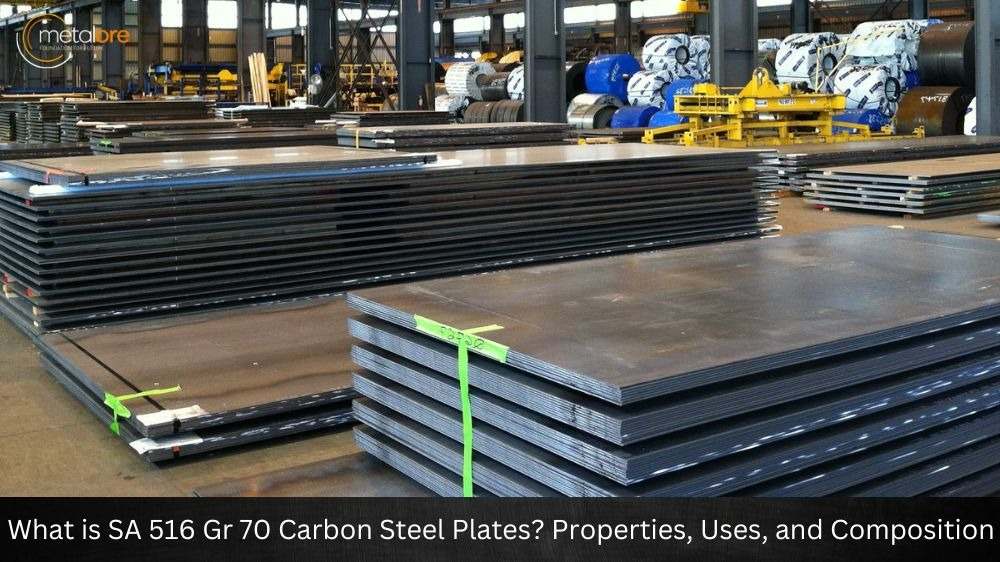
SA 516 Gr 70 carbon steel plates hold a central position in oil and gas, petrochemical, and power generation sectors. Formally designated ASME SA516 Grade 70 Boiler Quality Plate, these plates meet the pressure vessel and boiler standards set by ASME and carry a tensile strength range of 70 to 90 ksi, which makes them the default structural choice for engineers specifying pressure-critical components.
What is SA 516 Gr 70 Carbon Steel Plates?
SA 516 Gr 70 carbon steel plates contain carbon, manganese, phosphorus, sulfur, and silicon in controlled proportions, with manganese and silicon content held tighter than in grades like A516 Gr 60. That tighter chemistry delivers a tensile strength floor of 70 ksi alongside a yield strength minimum of 36 ksi. Engineers specify it repeatedly for a reason. The plate holds dimensional stability under cyclic loading and retains mechanical properties across a range of service temperatures, from sub-zero storage environments to elevated-temperature boiler applications.
Physical properties of SA 516 Gr 70 Carbon Steel Plates
Carbon content is at 0.27% maximum, a ceiling that keeps the plate weldable while giving it the load-bearing capacity pressure vessel fabricators need. Manganese additions between 0.85% and 1.20% improve toughness without requiring post-weld heat treatment in standard wall thicknesses. The yield strength floor of 240 MPa and tensile range of 485 to 620 MPa let fabricators calculate safety margins with precision.
Alloying elements in the composition slow surface oxidation, reducing the corrosion rate in atmospheric and mildly corrosive environments compared to plain low-carbon plates. That matters in above-ground storage tanks where maintenance cycles run years apart. Silicon content between 0.13% and 0.45% refines the grain structure during solidification, contributing to the impact toughness values the grade achieves at temperatures down to 0°C. Thermomechanical processing further tightens mechanical property consistency across plate thickness, which is why plate properties at the core match surface test results.
Uses of SA 516 Gr 70 Carbon Steel Plates
Pressure vessel fabricators choose SA 516 Gr 70 as the shell and head material for reactors, separators, and heat exchangers operating up to 345°C. Storage tank manufacturers use it for wall sections in crude oil and LPG tanks where wall thicknesses run from 6 mm to 150 mm. The plate absorbs welding heat without cracking, so fabricators run SMAW, GMAW, and SAW processes on it without preheat below 25 mm thickness.
Offshore platform designers specify SA 516 Gr 70 for structural components that must pass PWHT qualification, since the grade maintains impact toughness after heat treatment. Industrial machinery bases and factory flooring panels in heavy manufacturing environments also use this plate because the abrasion resistance it develops after surface hardening holds under repeated load cycles. In pressure piping systems, it pairs with A106 and A333 pipe grades as a fitting and flange blank, delivering matching mechanical properties at lower cost than pipe-specific material.
Composition of SA 516 Gr 70 Carbon Steel Plates
The chemical composition of SA 516 Gr 70 breaks down as follows: Carbon maximum 0.27%, Manganese 0.85% to 1.20%, Phosphorus maximum 0.035%, Sulfur maximum 0.035%, and Silicon 0.13% to 0.45%. Mechanical properties are in accordance with ASME Section II Part A, with tensile strength 485 MPa to 620 MPa, yield strength 260 MPa minimum and elongation 17% minimum in 200 mm gauge length.
Plates undergo testing at every production stage, from ladle chemistry checks at steelmaking through ultrasonic testing on finished plates. Supply options include thicknesses from 5 mm to 150 mm, widths from 1500 mm to 3500 mm, and lengths up to 12,000 mm. Normalized or as-rolled condition is available depending on thickness and application.
Conclusion
SA 516 Gr 70 carbon steel plates deliver a combination of 485 MPa tensile strength, full weldability, and pressure vessel code compliance that few carbon steel grades match at the same price point. Controlled chemistry, consistent mechanical properties and wide availability in standard and custom dimensions make these plates the primary material for boilers, pressure vessels, storage tanks and offshore structural components. Request a material test report and dimensional certificate with every order to confirm compliance before fabrication.
FAQs
What is SA 516 Gr 70 used for?
SA 516 Gr 70 plates go into pressure vessels, boilers, storage tanks, heat exchangers, and offshore structural components where tensile strength of 485 MPa minimum and full weldability are required.
Is SA 516 Grade 70 suitable for pressure vessels?
Yes. ASME Section VIII design codes list SA 516 Gr 70 as an approved pressure vessel plate material, rated for service up to 345°C in carbon steel vessel construction.
What thicknesses are available in SA 516 Grade 70 plates?
Plates stock from 5 mm to 150 mm thickness, with widths reaching 3500 mm and lengths up to 12,000 mm, available in as-rolled and normalized conditions.
Is SA 516 Grade 70 corrosion resistant?
The grade is more resistant to atmospheric oxidation than plain carbon steel, but requires coating or lining for service in an acidic or chloride environment or in high-humidity conditions outside the normal ambient conditions.
Why is SA 516 Grade 70 preferred in the oil and gas industry?
The combination of 70 ksi tensile strength, low sulfur content for sour service compatibility and ASME code certification meets most upstream and downstream vessel design requirements in one cost efficient plate grade.